
To Create or Not Create: Why Piano Students Should Learn to Improvise and Compose
The Question Every Piano Teacher Should Ask: “Why Improvise?”
Pianist and Professor of Music John Mortensen poses this critical question to his colleagues and students. His passionate answer reveals why improvisation and composition should be essential parts of every piano education.
The Powerful Benefits of Musical Creativity
1. Contribute Your Own Original Music
Instead of only reciting music others have created, students can express their unique musical voice and ideas.
2. Deeper Musical Understanding
Someone who improvises must understand how music works “on a molecular level.” This profound understanding transforms students from note-readers into true musicians.
3. Internalize Harmonic Knowledge
Through improvisation, harmonic concepts move from abstract theory to intuitive understanding that lives in your fingers and ears.
4. Demystify Music
Students begin to recognize the decisions composers made and understand the “why” behind the music, not just the “what.”
5. Brain Science Supports Improvisation
Functional MRI scans reveal fascinating differences in brain activity:
- Performing from memory activates brain areas responsible for personal monitoring and criticism
- Improvising activates brain areas responsible for self-expression and freedom
In other words, improvisation literally unlocks different, more creative parts of your brain.
6. Pure Joy
Improvising is simply a joyful experience – for both the performer and the audience.
7. Greater Audience Engagement
Audiences are more engaged watching improvised performances, feeling the spontaneity and authenticity of the moment.
What We’ve Discovered Teaching Piano Students
Working as music educators and piano teachers, we’ve noticed something remarkable:
Students Are Already Excited About Creating Music
We don’t need to convince students or parents that improvising and composing is worthwhile – they’re already sold on the idea before they come to our studio.
Every student wants to learn classics like “Für Elise,” but they also love to experiment and create their own music.
Real Stories from Our Studio
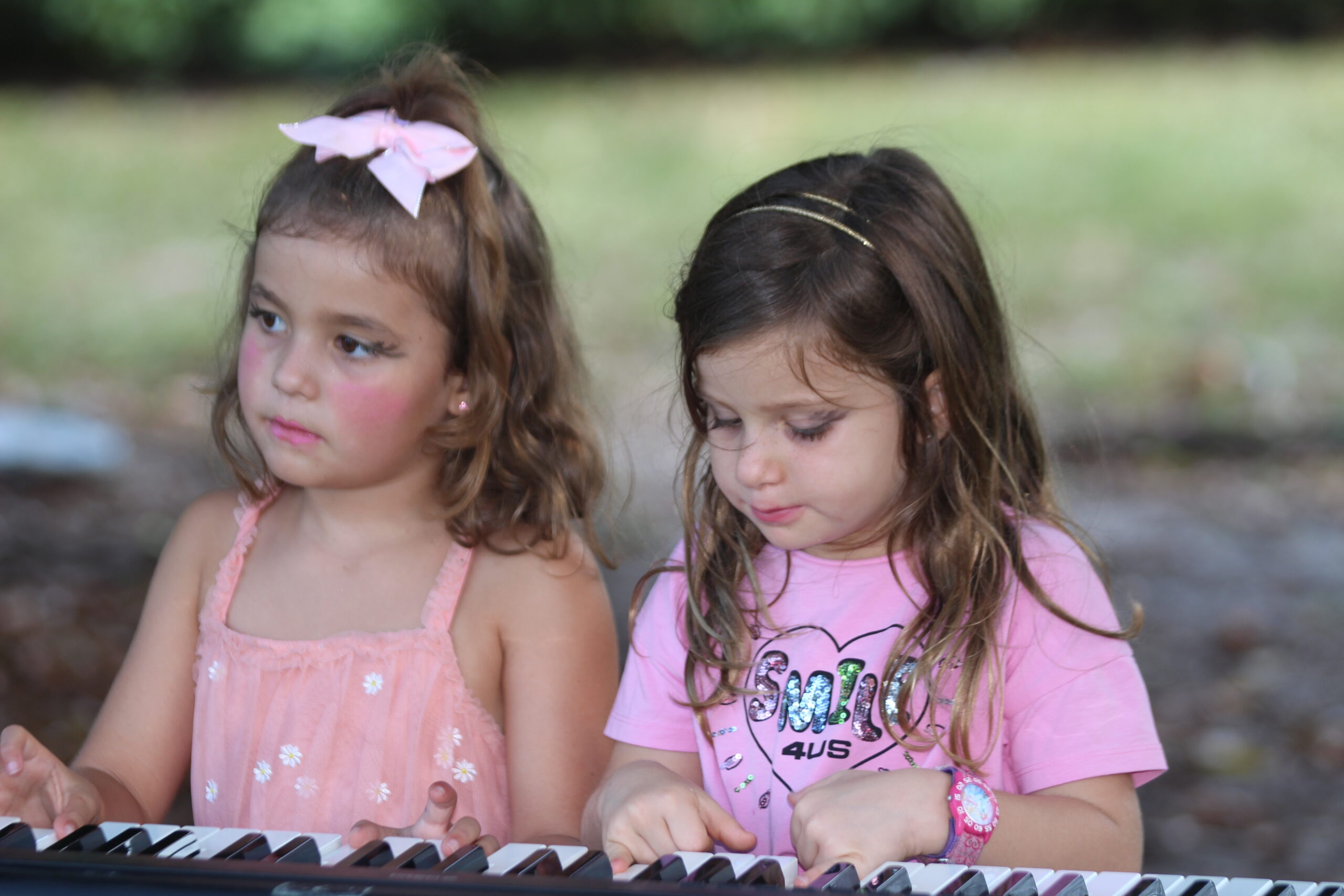
Parents frequently tell us about their children coming home from school and running straight to the piano to try out a musical idea.
This natural excitement becomes a powerful teaching tool. Instead of assigning dry technical exercises, we teach the same skills through creativity:
Traditional approach:
“Play a scale legato in one hand and repeated chords in the other.”
Creative approach:
“Here’s how you play a melody legato in one hand. Here’s how you play repeated chords in the other. Now go home and make up your own song.”
And they do! Students eagerly practice technical skills when they’re creating their own music.
A Personal Story: Losing and Rediscovering Creativity
Looking back at my own musical upbringing, I remember sitting down as an elementary student with blank sheet music paper, writing my own compositions. (The word “improvisation” wasn’t part of my vocabulary yet.)
When Schools Focus Only on Tradition
This creative outlet existed outside the instructional goals of my music school, which focused exclusively on reading notes to eventually learn the classics. I didn’t know anyone who composed or improvised.
Without guidance or encouragement, my interest in composition was eventually replaced by other interests.
Rediscovering Creativity as an Adult
I discovered improvisation later through jazz, and composition when I became a piano teacher needing material my students would find both interesting and educational.
Teaching Creativity: A Real Example
One of our students performs “The Haunted House” from the Brain-Based Piano Method Preparatory Level. While students are excited to play this piece (complete with costume and theatrical effects), they’re simultaneously learning:
- Bitonality (using two keys at once)
- Rondo Form (ABACA structure)
- Creative expression through music
Students learn advanced concepts joyfully when creativity is central to the experience.
Three Perspectives on Musical Creativity
Looking at improvisation, composition, and creativity in music education, we see three distinct accounts:
- A professor making the case for creativity to his academic colleagues
- Young students naturally excited about creating their own music
- An adult teacher who was interested in creativity as a youth, lost it through traditional education, and rediscovered it outside academia
Do Schools Kill Creativity?
This pattern raises an important question posed by Sir Ken Robinson: “Do Schools Kill Creativity?”
Whether schools are responsible or not, one thing is clear: we live in a time where the need for creative people has never been greater.
The Rising Demand for Creativity
Author Richard Florida makes a compelling case in his national bestseller The Rise of the Creative Class that creativity is no longer a luxury skill – it’s essential for success in the modern world.
Good News for Students and Parents
We also live in a time where knowledge about how to raise creative students is more available than ever before.
The path to creativity is open to everyone – including students and parents interested in pursuing it.
What This Means for Your Piano Education
The traditional model of piano education – learning only to reproduce existing pieces – is incomplete. A well-rounded musical education should include:
✓ Learning classical repertoire (Für Elise, Bach, Mozart)
✓ Understanding how music works at a deep level
✓ Improvising and expressing personal musical ideas
✓ Composing original pieces
✓ Developing creative thinking skills that extend beyond music
The Bottom Line
Students don’t need to be convinced that creating music is valuable – they already know it instinctively. They’re excited about it. They run to the piano to try their own ideas.
As educators and parents, our job is to nurture this natural creativity rather than replace it with purely mechanical skill-building.
When we combine technical excellence with creative freedom, we develop complete musicians – artists who can both honor tradition and contribute their own original voice to the world of music.
Ready to explore piano lessons that develop both technical skills and creative expression? The Brain-Based Piano Method integrates improvisation and composition from the very beginning, honoring students’ natural desire to create while building solid musical foundations.

